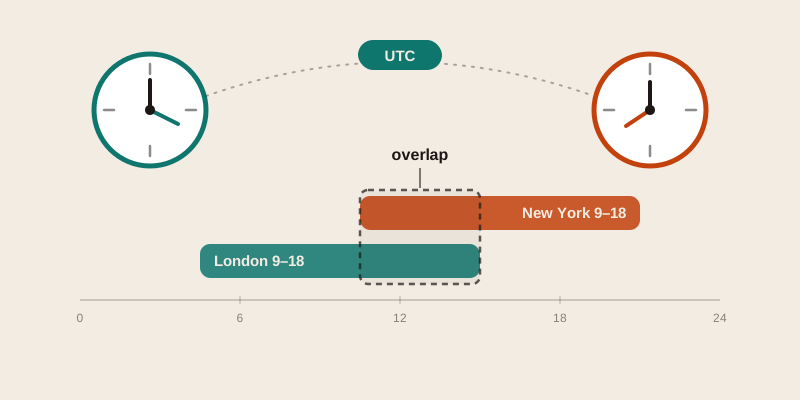
You know roughly what time it is on the other side of the world — but knowing the time difference and finding a slot that doesn't ruin someone's evening are two different problems. This is the practical half: how to land on a call time that is genuinely reasonable for everyone, even across two or three zones, and how to write the invite so nobody shows up an hour early.
The working-hours overlap, in one idea
Forget converting clocks for a moment. The only thing that matters when you schedule across zones is the overlap: the band of hours that falls inside a sensible working day in every location at once. If your day runs 9 a.m. to 6 p.m. and theirs does too, the question is simply where those two windows overlap on a shared timeline.
Picture both days laid end to end against a single reference clock. Your 9-to-6 covers a stretch; their 9-to-6 covers another stretch, shifted by the time difference. Wherever the two stretches sit on top of each other is fair game. Everything outside that band asks somebody to take the call before breakfast or after dinner.
Two consequences fall straight out of this:
- Small differences are easy. Two or three hours apart and you have a wide overlap — most of an afternoon to choose from.
- Large differences shrink the window fast. Past about seven or eight hours, the overlap narrows to an hour or two clinging to the edges of each day, and beyond roughly eleven or twelve hours it can vanish entirely. Someone has to bend.
How to find the overlap by hand
You can do this on paper in under a minute. The method works for any pair of cities.
- Pick one anchor zone. Usually your own. Write your working window in it, say 9 a.m.–6 p.m.
- Get the current difference for the actual date. Not a remembered rule — daylight saving moves it (more on that below). The cleanest way is to read both cities' live local times side by side.
- Translate their working window into your zone. If they are 8 hours ahead, their 9 a.m. is your 1 a.m. and their 6 p.m. is your 10 a.m.
- Find where the two windows touch. In that example, your 9 a.m.–6 p.m. and their (translated) 1 a.m.–10 a.m. overlap only from 9 a.m. to 10 a.m. your time. That single hour is your whole runway.
- Pick a time inside the band, not on its lip. A slot dead-centre in the overlap is forgiving if someone is a few minutes late or the difference is one of those off-by-an-hour transition weeks.
The arithmetic of the difference itself — offsets, the plus-and-minus signs, half-hour zones like India's UTC+5:30 — is covered step by step in our companion piece on time zones and UTC offsets. Here we assume you have the difference and care about what to do with it.
A worked overlap table
Here is the overlap for a few common pairings, assuming a 9 a.m.–6 p.m. working day on both ends and standard (winter) offsets. Read the last column as "times that are reasonable for everyone."
| City pair | Difference | Sensible overlap (their time / your time) |
|---|---|---|
| New York & London | 5 hours | Comfortable: roughly 1–5 p.m. London = 8 a.m.–12 p.m. New York |
| London & Dubai | 4 hours | Comfortable: 1–6 p.m. Dubai = 9 a.m.–2 p.m. London |
| London & Mumbai | 5.5 hours | Comfortable: 2:30–6 p.m. Mumbai = 9 a.m.–12:30 p.m. London |
| San Francisco & London | 8 hours | Tight: 5–6 p.m. London = 9–10 a.m. San Francisco |
| New York & Tokyo | 14 hours | None inside both 9–6; best compromise is early morning one side, evening the other |
| London & Sydney | 10–11 hours | Barely any; 8 a.m. London = 6–7 p.m. Sydney is the usual squeeze |
Notice how the advice shifts from "pick anything" to "there is exactly one slot" to "negotiate the pain." That progression is the whole game. The honest answer for New York–Tokyo or London–Sydney is that someone takes an awkward hour — the fair move is to rotate who, and to say so out loud.
The daylight-saving traps that wreck schedules
The single biggest cause of missed international calls is assuming the difference is fixed. It isn't. Clocks spring forward and fall back on different dates in different places, so the gap between two cities drifts by an hour for a few weeks each year — and occasionally lands you in a window where the usual difference is simply wrong.
The "switch weeks" gap
The United States and Europe both observe daylight saving, but they change clocks on different weekends — the US typically a couple of weeks before Europe in spring, and again out of sync in autumn. During those gaps, New York–London is 4 hours apart instead of the usual 5. A recurring weekly call booked "5 hours apart, always" slips by an hour and someone joins late.
The hemisphere reversal
When the northern hemisphere springs forward, the southern hemisphere is falling back. So London–Sydney isn't a steady gap at all — it swings by two full hours across the year, and there's even a brief stretch when neither side has shifted yet. Memorising "11 hours" guarantees you'll be wrong for part of the year.
Places that don't move at all
Much of Asia, most of Africa, the Gulf, and pockets like Arizona keep one offset all year. That sounds simpler, and it is — but it means the difference between, say, London and Dubai changes only because London moves, which is easy to forget when you're thinking about Dubai.
The defence against all three is the same: never reuse a remembered difference for a date in a different season. Check the actual local times for the specific day of the call. Our time in any place tool shows the current local time, the UTC offset, and whether daylight saving is in effect for any city you search — which is exactly the input the overlap method needs.
What counts as a fair time
The overlap tells you what's possible; courtesy tells you what's kind. A slot can sit technically inside both working days and still be a bad idea.
- Protect the edges of the day. 9 a.m. sharp on someone's Monday, or 5:55 p.m. on their Friday, is inside the window but rarely welcome. Aim for the calmer middle hours where you can.
- Watch the lunch valley. Roughly noon to 1 or 2 p.m. local is a soft no in many places. A slot that looks great on the overlap chart can collide with someone's only break.
- Mind the weekend offset. When the difference is large, your Friday afternoon can be their Saturday morning. The Gulf weekend (Friday–Saturday in some countries) trips up plenty of schedulers, too.
- Rotate the discomfort. For wide gaps with no good overlap, the fairest pattern is to alternate who takes the early-morning or late-evening slot, and to name that arrangement explicitly rather than always defaulting to the same person bending.
If you're not sure how far apart the cities are in the first place — and therefore how brutal the math might get — our distance between cities tool gives you a quick sense of how deep into "someone's evening" you're really reaching.
Writing the invite so nobody gets it wrong
You've found a fair slot. Now state it in a way that survives forwarding, copy-pasting, and the recipient's own assumptions. A few rules make time-zone invites bulletproof.
- Always name the zone. "3 p.m." alone is the classic disaster. Write "3 p.m. London."
- Show both (or all) local times. Spell it out for each side so nobody has to do mental math: "3 p.m. London / 10 a.m. New York."
- Anchor it to UTC once. Adding the UTC reference removes every ambiguity, especially for a reader in a fourth zone you didn't think about: "3 p.m. London / 10 a.m. New York (UTC+1 / UTC-4)."
- Prefer city names over abbreviations. "CST" means Central Standard Time to one reader and China Standard Time to another. "Chicago" or "Shanghai" can only mean one thing.
- Pin the date, not just the time. Across a large difference, your evening call may already be the recipient's next calendar day. "Tuesday 8 p.m. New York (Wednesday 9 a.m. Tokyo)" prevents a 24-hour miss.
- Let the calendar do the conversion. A proper calendar invite stores the event in one true instant and renders it in each attendee's local zone automatically. Use it as the source of truth, and keep the written-out times as a human-readable backup.
A clean three-zone example, all in one line: "Wed 14 May, 2 p.m. London / 9 a.m. New York / 6:30 p.m. Mumbai (UTC+1 / UTC-4 / UTC+5:30)." Anyone reading that, anywhere, knows exactly when to show up.
Three zones at once
Adding a third city doesn't change the method — it just tightens the band. The overlap now has to satisfy three working days, so it's the intersection of three windows rather than two. With New York, London, and Mumbai, the only comfortable common ground is roughly mid-morning New York / early-afternoon London / late-afternoon Mumbai. Add a fourth zone across the Pacific and the comfortable overlap usually disappears, which is your signal to either rotate times week to week, record the meeting for whoever can't make it, or split into two calls.
A quick triage for the impossible cases: if no slot fits everyone's 9-to-6, widen the definition slightly (many people will happily take an 8 a.m. or a 7 p.m. they chose themselves), confirm whether anyone is flexible, and only then resort to asking one person to take a genuinely awkward hour — fairly, and by turns.
Put it into practice
Finding a fair call time is really just three moves: read the true local time for the date, lay the working windows over each other to find the overlap, and write the invite in every zone plus UTC. The math is trivial; the discipline is checking the live time instead of trusting a memorised difference that daylight saving has broken.
Start by reading the exact current time and offset for each city in the time in any place tool, then sketch the overlap and lock in a slot. If you're scheduling around travel rather than a call, pair it with the distance between cities tool to gauge the journey, and the country info tool to confirm the country, its region, and calling code before you reach out. Local working days and public holidays vary by country, so it's worth checking the destination's calendar separately before you propose a time someone's office is closed.