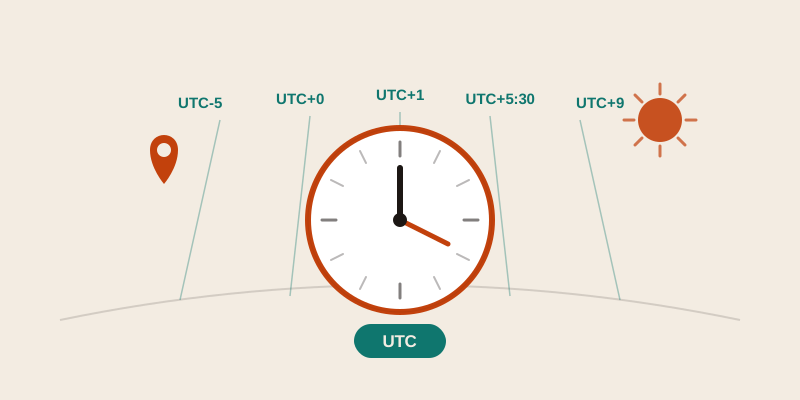
You are setting up a video call with someone in Tokyo, or planning a layover in London, or just trying to text a friend who moved abroad without waking them at 3 a.m. The question is always the same: what time is it there, right now? The answer hides behind a few ideas — UTC, offsets, time zone names, and daylight saving — that sound technical but are genuinely simple once you see how they fit together.
UTC: the world's master clock
Every local time on Earth is described in relation to one shared reference: Coordinated Universal Time, or UTC. Think of UTC as a single, unmoving clock that the whole planet agrees on. It never changes for the seasons and it does not belong to any particular country. London happens to sit close to it, but UTC is a standard, not a place.
Your local time is just UTC shifted forward or backward by a fixed amount. That shift is called an offset. Write it with a plus or minus sign and the number of hours and minutes, like UTC+9 or UTC-5. Once you know a place's offset, finding its current time is simple arithmetic: take UTC and add the offset.
- UTC+9 means 9 hours ahead of the master clock (that's Tokyo).
- UTC-5 means 5 hours behind it (that's New York in winter).
- UTC+0 means right on it (that's London in winter).
You may also see "GMT" used the same way as UTC in everyday conversation. They are practically interchangeable for civil timekeeping, so if a flight says "GMT+1," read it as UTC+1.
How offsets actually work
Offsets are the heart of every "what time is it there" calculation. Here is the whole method in two steps: convert your local time to UTC, then convert UTC to their local time.
Say it's 3:00 p.m. in New York (UTC-5) and you want Tokyo time (UTC+9):
- New York is UTC-5, so add 5 hours to get UTC: 3:00 p.m. becomes 8:00 p.m. UTC.
- Tokyo is UTC+9, so add 9 hours to UTC: 8:00 p.m. + 9 = 5:00 a.m. the next day in Tokyo.
The difference between the two cities is simply the difference between their offsets: 9 minus (-5) equals 14 hours. Tokyo is 14 hours ahead of New York. A handy shortcut: (their offset) minus (your offset) = how many hours ahead they are. If the result is negative, they are behind you instead.
One more wrinkle worth knowing: not every offset is a whole hour. India runs at UTC+5:30, Nepal at UTC+5:45, and parts of Australia at UTC+9:30. So when you do the math, remember to carry those half- and quarter-hour pieces.
IANA time zone names: why "America/New_York" beats "EST"
Abbreviations like EST, PST, or CET are friendly but ambiguous — several different regions share the same letters, and they don't tell you what happens in summer. That's why software uses the IANA time zone database, where each zone has a clear name built from a region and a representative city:
| IANA name | Common label | Winter offset |
|---|---|---|
| America/New_York | Eastern Time | UTC-5 |
| Europe/London | GMT | UTC+0 |
| Europe/Paris | Central European | UTC+1 |
| Asia/Tokyo | Japan Time | UTC+9 |
| Asia/Kolkata | India Time | UTC+5:30 |
The magic of an IANA name is that it carries the rules, not just a single offset. "America/New_York" knows its own history of daylight saving changes, so a computer can tell you the correct time for any date — past, present, or future — without you tracking the politics yourself.
Daylight saving time: the offset that moves
Here is the catch that trips everyone up: many regions change their offset twice a year. In spring they shift the clock forward an hour to make better use of evening daylight; in autumn they shift it back. So New York is UTC-5 in winter but UTC-4 in summer, and Paris swings between UTC+1 and UTC+2.
This means the time difference between two cities is not always constant. A few things make it especially messy:
- Not everyone observes it. Most of Asia, Africa, and places like Arizona keep one offset all year.
- The dates don't line up. The U.S. and Europe switch on different weekends, so for a couple of weeks each spring and autumn the usual difference is off by an hour.
- The southern hemisphere is reversed. When it's summer in Europe, it's winter in Australia, so their clocks move the opposite way.
This is exactly why memorizing a fixed difference ("they're always 6 hours ahead") will eventually let you down. The safe approach is to check the actual current time for the specific place and date.
Figuring out the time before a call or trip
For a quick, reliable answer, skip the mental math and let a tool apply the live offset and daylight saving rules for you. Our time in any place tool shows the current local time, the UTC offset, and whether daylight saving is in effect for any city or country you search.
A simple routine that always works:
- Pin your anchor. Note your own current time and offset first.
- Look up their local time for the exact day you care about — not a remembered rule.
- Find an overlap. For scheduling, look for hours that are reasonable on both ends, roughly 8 a.m. to 8 p.m. in each place.
- Confirm in writing. When you propose a meeting, state the time in both zones and add "UTC" once, so there's no ambiguity: "2 p.m. London / 9 a.m. New York (UTC+1 / UTC-4)."
Planning a trip rather than a call? The time difference and the physical distance go hand in hand. Once you know where you're headed, our distance between cities tool helps you gauge travel time, while the time-in-place tool tells you what your watch should read when you land.
Putting it all together
Time zones feel chaotic only because three things move at once: the offset from UTC, the seasonal daylight saving shift, and your own location. Anchor everything to UTC, treat IANA names as the trustworthy source of the rules, and remember that the difference between two places can change with the seasons. Do that, and "what time is it there?" stops being a guessing game.
Next time you're booking a call or a flight, start with the time in any place tool to read the exact local time and offset, then check the distance between cities to round out your plan. A few seconds of checking beats a missed meeting or a 3 a.m. text every time.