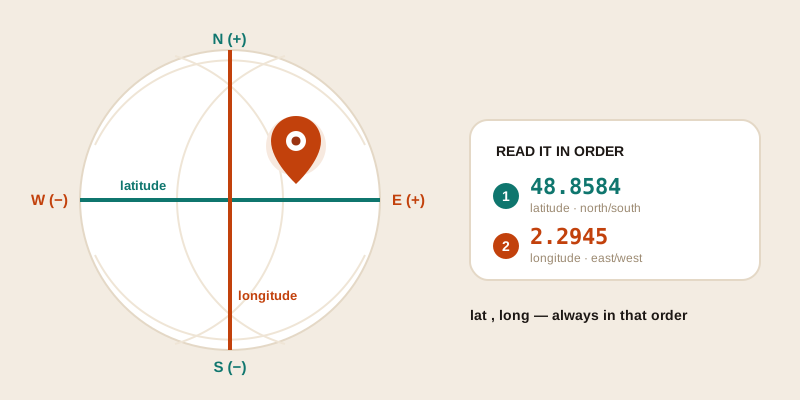
Someone hands you a pair of numbers — say 48.8584, 2.2945 — and tells you it's a location. But which number is which? And what happens if you read them in the wrong order? This is one skill: taking an existing coordinate pair and confidently reading it, so you know exactly where on Earth it points without second-guessing yourself.
Two numbers, two questions
Every spot on the planet can be described by just two numbers. The trick is knowing that each one answers a different question.
- Latitude answers: how far north or south am I? It's measured from the equator (0) up to the North Pole (+90) and down to the South Pole (-90). Think of latitude as the horizontal lines that stack up the globe like the rungs of a ladder.
- Longitude answers: how far east or west am I? It's measured from the Prime Meridian — the line that runs through Greenwich, London (0) — out to +180 going east and -180 going west. Longitude lines are the vertical slices that run pole to pole, like the segments of an orange.
Here's a memory hook that sticks: latitude is flat (both words start with "la"-ish sounds and the lines lie flat, side to side), while longitude is the long way, running the full length of the globe from top to bottom. Once that clicks, you'll never confuse which set of lines is which.
Which comes first: latitude or longitude?
This is the single most-asked question about coordinates, and the answer is reassuringly simple: latitude always comes first, longitude second. It's written "lat, long" — alphabetical order, conveniently — and almost every map app, GPS device, and website follows this convention.
So in 48.8584, 2.2945, the first number (48.8584) is the latitude and the second (2.2945) is the longitude. That pair lands you at the Eiffel Tower in Paris.
The "alphabetical" rule (A comes before O, lat before long) is the easiest way to remember it. If you ever see a coordinate and aren't sure, ask yourself which number could possibly be a latitude. Latitude can never go beyond 90 in either direction — so if one of your two numbers is larger than 90 (like 122 or -151), it must be the longitude, and the pair is either out of order or already written longitude-first. That single check resolves a huge share of mix-ups.
What N, S, E and W actually mean
Coordinates often come decorated with compass letters: 40°N, 74°W, and so on. These letters do one job — they tell you which side of the two "zero" lines you're on.
| Letter | Direction | Applies to | Reference line |
|---|---|---|---|
| N | North | Latitude | Above the equator |
| S | South | Latitude | Below the equator |
| E | East | Longitude | East of the Prime Meridian |
| W | West | Longitude | West of the Prime Meridian |
Notice the pairing: N and S only ever attach to latitude, and E and W only ever attach to longitude. That's another quiet clue for figuring out which number is which. If a value carries an N or an S, it's the latitude — full stop. If it carries an E or a W, it's the longitude.
So "40°42'N, 74°00'W" reads as: 40 and a bit degrees north of the equator, 74 degrees west of Greenwich — which is New York City.
Plus and minus: signs do the same job as letters
Most digital coordinates skip the letters and use a plus or minus sign instead. The two systems mean exactly the same thing, and it's worth learning how they map onto each other so you can read either at a glance.
- Positive latitude = North. A value like 40.69 (no sign shown, so it's positive) is north of the equator. The plus is usually left off.
- Negative latitude = South. A value like -33.87 is south of the equator — Sydney, for instance.
- Positive longitude = East. A value like 2.29 is east of the Prime Meridian.
- Negative longitude = West. A value like -74.04 is west of Greenwich.
So the letter-style "33°52'S, 151°12'E" and the decimal-style "-33.87, 151.21" describe the very same point in Sydney. The minus sign is doing the work of the "S"; the plain positive number is doing the work of the "E".
This is exactly why a missing minus sign is so dangerous. Drop the minus from -74.04 and you flip from west to east — from New York's longitude clear across to central Asia. Whenever you copy or type a coordinate, the sign is not decoration. It's half the meaning.
The most dramatic mistake: swapping the two values
If forgetting a sign sends you to the wrong hemisphere, swapping latitude and longitude can send you somewhere truly bizarre. It's the classic beginner error, and it happens because the two numbers look interchangeable until you think about their ranges.
Take the Eiffel Tower again: 48.8584, 2.2945. Read correctly, that's Paris. Swap the order to 2.2945, 48.8584 and you're now claiming a latitude of 2.3 (just north of the equator) and a longitude of 48.9 (deep in eastern Africa) — you've landed in the middle of Somalia, thousands of kilometres off.
Here's how to catch a swap before it bites you:
- Check the 90 rule. Latitude can never exceed 90. If your first number is bigger than 90, the pair is reversed. (Longitude is the only one allowed up to 180.)
- Sanity-check the hemisphere. If you know roughly where the place should be — northern hemisphere, western half of the world — confirm the signs match. A US location should have a positive latitude and a negative longitude. If yours doesn't, look again.
- Eyeball it on a map. The fastest check of all: paste the pair into a tool and see where the pin drops. If it's in the ocean when you expected a city, you've probably swapped or dropped a sign.
That last step takes seconds. Drop the numbers into our GPS to address tool and it turns the pair into a plain street address — if the address looks nothing like where you expected to be, the coordinate is almost certainly reversed or missing a sign.
Reading a coordinate, step by step
Let's put it all together with a worked example. Suppose someone sends you: -22.9519, -43.2106.
- First number is latitude: -22.9519. It's negative, so we're south of the equator, about 23 degrees down.
- Second number is longitude: -43.2106. It's negative, so we're west of Greenwich, about 43 degrees over.
- Picture it: southern hemisphere, western side of the globe — South America fits. This one is the Christ the Redeemer statue in Rio de Janeiro.
That's the whole method: identify which number is the latitude (always first), read its sign or letter for north/south, then do the same for the longitude and east/west. With a little practice you'll read a coordinate as naturally as you read a date.
A quick word on formats
You'll meet coordinates in two written styles, but they say the same thing. Decimal degrees (-22.9519, -43.2106) is the plain-number format used by apps and websites — easy to copy and paste. Degrees, minutes, seconds (22°57'07"S, 43°12'38"W) splits each degree into 60 minutes and each minute into 60 seconds, and shows up on nautical charts and older GPS units. The reading rules don't change: latitude first, then longitude; N/S then E/W. If you'd like a fuller tour of both formats and how to find coordinates in the first place, see how to find the GPS coordinates of any place.
Read it right, every time
Reading coordinates comes down to three habits: remember latitude first (alphabetical, "lat then long"), treat the sign or letter as half the meaning (minus is south or west, just like S or W), and run the 90 check to catch a swap. Do those three things and you'll never again wonder whether a pair of numbers points to Paris or the open ocean.
Want to see a coordinate come to life? Paste any latitude/longitude pair into our GPS to address tool to turn it into a readable place, or use the "where am I" tool to read your own coordinates right now and practise on a pair you already trust. If you need to grab the coordinates of somewhere specific, the find GPS coordinates tool hands you a clean, correctly ordered pair every time.