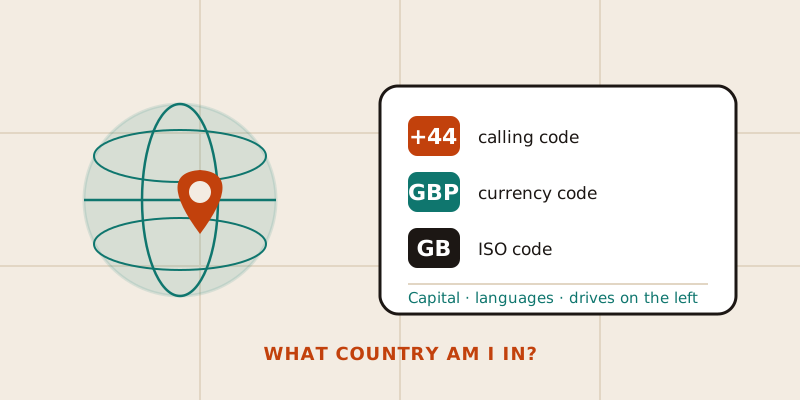
Two small questions come up constantly when you're travelling or just poking at a map: which country is this place in, and what do its quick facts actually mean? A phone number starts with +44, a price tag says kr, a passport stamp reads CHE — each is a tidy little code, and each tells you something useful once you know how to read it. Here's the literal "what country am I in," then the reference facts that follow: calling codes, currencies, ISO codes, capitals, languages, and which side of the road people drive on.
"What country am I in?" — figuring out the place first
Most of the time you already know roughly where you are. But there are real moments when you don't: you've crossed a land border on a train, you're in a border town where two countries blur together, or you've landed somewhere after a long flight and the signage is in a script you can't read. There are a few reliable ways to settle it.
- Your device's location. The fastest answer is to ask your phone where it is. A browser tool like where am I reads your GPS position and resolves it to a place, so you can see the country (and the city) without installing anything.
- Reverse-geocoding a coordinate. If you only have a latitude and longitude — say someone shared a pin — paste it into GPS to address and it returns a formatted address with the country spelled out at the end.
- The clues already around you. Phone numbers, currency symbols, plug shapes, and road signs all hint at the country. Those clues are exactly the "country facts" the rest of this guide unpacks.
Once you have the country name, the country info tool turns it into a single reference card: capital, region, calling code, currency, languages, ISO codes, and the country's domain ending, all in one place. The sections below explain what each of those fields means so the card actually tells you something.
Calling codes: what "+44" really is
A country calling code is the number you dial to reach a phone in another country. The leading + is shorthand for "the international access prefix for wherever I'm calling from" — on most mobile phones you can type the + directly and the network sorts out the rest. So +44 routes your call into the United Kingdom, +1 covers the United States and Canada, +91 is India, and +81 is Japan.
A few things trip people up:
- The codes vary in length. Some are one digit (
+1), most are two or three. They were handed out by world region — codes starting with 1 are North America, 2 is largely Africa, 3 and 4 are Europe, and so on — which is why neighbours often share a first digit. - One code can cover several countries.
+1is shared across the US, Canada, and much of the Caribbean. The calling code alone doesn't always pin down a single nation. - Watch the leading zero. Many countries write local numbers with a leading
0(a "trunk prefix") that you drop when dialling internationally. A London number written020 7946 0000becomes+44 20 7946 0000from abroad — the0falls away.
So when you see an unfamiliar + code on a missed call or a business card and wonder "what is +44," you're really asking which country that code belongs to. Looking the code up by country (or the country up by code) is one of the things the country info tool is built for.
Currency and currency codes
The next fact most travellers want is the money. Every country has an official currency, and alongside its everyday symbol it carries a three-letter currency code set by an international standard (ISO 4217). The code is what banks, airlines, and exchange apps use because symbols are ambiguous — several countries use a "$" or a "kr," but each has its own unambiguous code.
| Country | Currency | Symbol | Code |
|---|---|---|---|
| United States | US Dollar | $ | USD |
| Eurozone | Euro | € | EUR |
| Japan | Japanese Yen | ¥ | JPY |
| United Kingdom | Pound Sterling | £ | GBP |
| India | Indian Rupee | ₹ | INR |
The first two letters of a currency code usually echo the country's two-letter code, and the last letter is the currency's initial: USD is US + Dollar, JPY is Japan + Yen, GBP is Great Britain + Pound. Knowing the code is handy in practice: it's what you type into an exchange-rate search, and it removes the guesswork when a "$" could mean US, Canadian, Australian, or any number of other dollars. Note too that a currency isn't always tied to one country — the euro is shared across the Eurozone, and several smaller nations officially use the US dollar.
ISO country codes: the 2- and 3-letter shorthand
You've already met currency codes; countries themselves have codes too, defined by the ISO 3166 standard. There are two everyday flavours, and it helps to know which is which.
- Two-letter codes (ISO alpha-2):
US,GB,FR,JP,IN. These are the ones you see most often — they're the basis of internet domain endings (.fr,.jp) and turn up in shipping forms and apps. - Three-letter codes (ISO alpha-3):
USA,GBR,FRA,JPN,IND. These appear on passports, in sports broadcasts, and anywhere a slightly more readable code is wanted.
A couple of these regularly surprise people. The United Kingdom is GB / GBR, not "UK," because the codes are based on the formal name "Great Britain." Switzerland is CH / CHE, from its Latin name Confoederatio Helvetica — which is also why Swiss cars carry a "CH" sticker. The codes are deliberately stable and language-neutral, which is exactly why software leans on them instead of country names that change spelling from one language to the next.
Capital, languages and the side of the road
Three more facts round out a country's reference card, and each has a real-world payoff.
The capital is the seat of government — Tokyo for Japan, Canberra (not Sydney) for Australia, Ottawa (not Toronto) for Canada. It's worth a glance because the best-known city isn't always the capital, and that catches people out in quizzes and conversation alike.
Official languages tell you what to expect on signs and documents, and how many languages to expect. Plenty of countries have more than one: Switzerland recognises four, Canada uses English and French, and South Africa lists eleven. Knowing the official language ahead of a trip is the difference between confidently reading a menu and squinting at a translation app.
Driving side is the fact that can genuinely keep you safe. Most of the world drives on the right, but a sizeable group — including the UK, Ireland, Japan, India, Australia, and much of southern Africa — drives on the left. If you're renting a car or even just crossing a street on foot, checking which side a country drives on before you arrive is a small habit that prevents a nasty surprise at the first roundabout.
Putting the card together
Here's how the pieces fit. Start with the place — confirm the country with where am I or by reverse-geocoding a pin in GPS to address. Then read its facts: the + calling code for phoning ahead, the currency and its three-letter code for money, the two- and three-letter ISO codes for forms and software, plus the capital, region, and official languages. None of it is complicated once each code stops being a mystery and starts being a label. For the trip itself you'll also want to check practical details the reference card doesn't cover, like which side of the road the country drives on.
Want all of that on one screen? Type a country name into the country info tool and it lays out the capital, region, calling code, currency, official languages, ISO codes, and the country's domain ending at a glance — the fastest way to go from "what country am I in" to actually knowing the place.