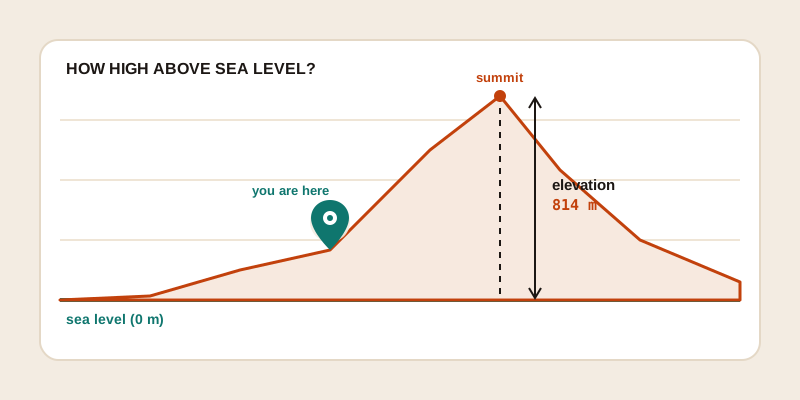
Stand still for a moment and your phone can tell you your latitude and longitude to a few metres. Ask it how high you are above the sea, though, and the answer gets surprisingly slippery — two devices in the same spot can disagree by tens of metres. So what does "elevation" really measure, why does it differ from "altitude," why do your GPS and a hiking barometer rarely agree, and where does the number actually matter in everyday life?
What "above sea level" really means
The phrase height above sea level sounds simple, but it hides a genuine question: which sea, and at what moment? The ocean is never flat. Tides raise and lower it twice a day, storms pile water against coastlines, and the sea's average height isn't even the same from one ocean to the next.
To get a usable, fixed reference, surveyors don't use the water you can see. They use an imaginary surface called the geoid — roughly, the level the oceans would settle to if they were calm and could flow freely under the continents, shaped by the Earth's gravity. Gravity is slightly stronger where there's more mass below (mountains, dense rock) and weaker elsewhere, so the geoid is gently lumpy rather than a smooth ball. When a map says a town sits at "120 m," it means 120 metres above this gravity-defined sea-level surface, not above whatever tide is lapping the nearest beach today.
The practical takeaway: a single, agreed reference exists, but it's a model, not a measurement of the water at your feet. That model is exactly why different devices, using different references, can hand you different numbers for the same hilltop.
Elevation vs altitude: are they the same thing?
People use the words interchangeably, and in casual speech that's fine. In careful use they describe different things, and the distinction clears up a lot of confusion.
- Elevation is the height of a point on the ground above sea level. A trailhead, a city, a mountain summit — these have elevations. The number doesn't change unless the land itself changes.
- Altitude usually means the height of something in the air above a reference — an aircraft, a drone, a balloon. It's a moving quantity.
- Height is the looser word for distance above a surface, and it depends entirely on which surface you mean.
Aviation adds its own vocabulary that's worth recognising even on the ground. Pilots distinguish altitude above mean sea level (AMSL) from height above ground level (AGL). A plane cruising at 35,000 ft AMSL over a 1,000 ft plateau is only 34,000 ft above the dirt below it. Mix the two up and the maths goes badly wrong — which is precisely why the field keeps the terms separate.
| Term | Measures the height of | Reference surface | Changes over time? |
|---|---|---|---|
| Elevation | A point on the ground | Sea level (geoid) | No, in practice |
| Altitude (AMSL) | Something in the air | Sea level (geoid) | Yes |
| Height (AGL) | Something in the air | The ground directly below | Yes |
Why your GPS and your barometer disagree
If you've ever watched two devices report different heights side by side, you've met the two completely different ways of measuring "up." Neither is broken; they answer the question by different means.
GPS height: geometry from satellites
A GPS receiver works out where it is by timing signals from several satellites. The vertical part of that fix is its weakest dimension — the satellites are mostly spread out across the sky rather than directly overhead, so the geometry that nails down your horizontal position is far less favourable for height. As a rough rule of thumb, vertical error from a phone is often two to three times its horizontal error.
There's a second catch. Raw GPS measures height above a smooth mathematical model of the Earth called the ellipsoid (specifically WGS-84), not above the lumpy geoid we call sea level. The gap between the two — the geoid height — varies around the world from roughly negative 100 to positive 80 metres. Good software applies a correction to convert ellipsoidal height into sea-level elevation; cheaper or raw readouts may skip it, which alone can throw the number off by tens of metres.
Barometric height: air pressure as a ruler
The other method ignores satellites entirely and reads air pressure, which falls predictably as you climb. Many phones, fitness watches, and dedicated altimeters include a tiny pressure sensor. Pressure-based height is wonderfully responsive — it catches a few metres of climb on a staircase that GPS would never notice — which is why step-and-stairs trackers rely on it.
Its weakness is that air pressure also changes with the weather. A passing low-pressure system can make a stationary barometer "rise" by tens of metres over a day without you moving an inch. That's why serious altimeters ask you to calibrate at a known point — a marked trailhead, a benchmark, a sea-level shore — before a hike. Calibrate at the bottom, and the climb you measure will be accurate even if the absolute starting figure was off.
So which should you trust?
- For a single absolute number ("how high is this town?"), a good elevation database — built from surveyed and satellite-mapped terrain — beats any live sensor. That's what a dedicated lookup uses.
- For changes during an activity (climb on a hike, descent on a ride), a calibrated barometer is hard to beat.
- For a quick on-the-spot estimate, GPS height is fine if you remember it can be off by tens of metres and you don't treat the last digit as gospel.
How an elevation lookup gets the number
When you ask a tool "what's the elevation here?", it usually isn't reading a sensor at all. It takes your coordinates and looks them up in a digital elevation model (DEM) — a vast grid where every cell stores the surveyed ground height for that patch of the planet. These grids are assembled from satellite radar, aircraft laser scanning (LiDAR), and ground surveys, then stitched together.
Understanding that it's a grid explains the quirks:
- Resolution matters. If each grid cell covers, say, 30 metres, the tool returns the average height of a 30 m square, not the exact pebble you're standing on. On a steep slope, the true spot can sit several metres above or below the reported value.
- Sharp features get smoothed. A narrow ridge, a cliff edge, or the very tip of a summit can be flattened by the grid, so peaks sometimes read a touch low.
- Surface vs bare earth. Some models include treetops and rooftops (a "surface" model); others strip them to bare ground. In a forest or a city, that choice can shift the answer by the height of the canopy or the building.
This is also why an accurate elevation depends on accurate coordinates going in. If you're not certain of your exact position first, it's worth confirming it with the where am I tool or pinning the precise spot with find GPS coordinates before you read the height — a lookup can only be as good as the point you feed it.
A worked example: reading a day on a hill
Imagine a half-day walk. You start at a marked trailhead and finish at a summit, checking three sources along the way. Here's the kind of spread you might genuinely see — and how to interpret it.
| Point | Elevation database | Phone GPS | Barometer (calibrated at start) |
|---|---|---|---|
| Trailhead | 312 m | 305 m | 312 m (set here) |
| Saddle | 540 m | 551 m | 539 m |
| Summit | 814 m | 798 m | 815 m |
Three lessons fall out of this table. First, the database and the calibrated barometer agree closely, because both are tied to real surveyed heights. Second, the GPS wanders by roughly ten to fifteen metres in each direction — normal vertical noise, not a fault. Third, and most useful: the figure you probably care about, total climb, is the difference between start and finish. From the database that's 814 − 312 = 502 m of ascent. Even where the absolute numbers disagree, the climb computed from a calibrated barometer (815 − 312 = 503 m) lands almost exactly the same. For activities, the change is more trustworthy than any single reading.
Where elevation actually matters
It's easy to treat elevation as trivia, but it shapes a lot of decisions.
Hiking and the mountains
Total ascent — not distance — is what tires your legs and sets your pace. A "flat" 15 km with 900 m of climb is a far harder day than a hilly 20 km with 200 m. Elevation also drives weather and oxygen: temperature falls by very roughly 6.5 °C per 1,000 m of ascent in typical conditions, and above about 2,500 m many people start to feel thinner air. Knowing the top's elevation before you set off tells you how much to pack.
Cycling and running gradients
A road's gradient is just the rise in elevation divided by the horizontal distance, written as a percentage. Climb 80 m over 1,000 m of road and that's an 8% gradient — a genuinely tough pitch. Gradient is pure elevation maths, which is why cyclists obsess over accurate height profiles: a sensor glitch that invents fake climbs can make a route look far harder than it is.
Flood, drainage, and where the water goes
Water flows downhill, so even a metre or two of elevation decides which homes flood and which stay dry. Flood maps, drainage planning, and "is this plot above the river line?" questions all rest on precise ground heights. Here the difference between a 30 m grid and a fine LiDAR model is the difference between a vague guess and a usable answer.
Weather, aviation, and everyday context
Weather stations report pressure "reduced to sea level" precisely so that readings from a coastal town and a mountain city can be compared at all. Boiling water cools as you climb (water boils below 100 °C at altitude, which is why high-altitude baking needs tweaks), and even mild altitude can affect engines, athletes, and sleep. Elevation is the hidden variable behind a lot of "why is it different up here?" moments.
Getting a reliable elevation, step by step
- Pin the right spot first. Elevation is meaningless without an accurate position, so confirm your coordinates before you read the height. The where am I tool is the quickest way to lock onto your current location.
- Use a database for absolute height. For the single "how high is this place?" number, look it up rather than trusting a live sensor — the elevation of a place tool reads it from surveyed terrain data.
- Calibrate a barometer before relying on it. If you're tracking a climb, set your altimeter at a known elevation at the start of the activity.
- Compare differences, not just totals. For climbs and gradients, the change between two points is more dependable than either absolute reading.
- Mind the resolution. On steep ground, near cliffs, or under tree cover, treat the figure as the height of a small patch, not a pinpoint — and don't over-read the final digit.
Putting it together
"How high above sea level am I?" turns out to be three questions in one: which sea, measured by which method, at what resolution. Once you know that elevation is height of the ground above a gravity-defined sea-level model, that GPS and barometers measure it in completely different ways, and that lookup tools read it from a grid of surveyed terrain, the small disagreements stop being mysterious. Trust databases for absolute heights, calibrated barometers for change, and always start from an accurate position.
Want the number for where you are right now? Drop your spot into the elevation of a place tool to read its height above sea level from surveyed terrain data — and if you need to nail the exact coordinates first, the where am I tool and find GPS coordinates tool will get you a precise point to look up.